Achieving true cost-effectiveness in a crushing and sand making production line does not mean buying cheap equipment, it means aligning every investment with corresponding output at every design decision point. Every design choice in the production line, whether the number of crushing stages, the length of belt conveyors, equipment selection, or the number of stockpiles, directly translates into total investment.
Ethiopia's industrial base is still developing. When clients procure a crushing production line, beyond the main machines they typically also need to source the complete supporting package, including steel structures, belt conveyors, cables, electrical cabinets, and spare parts. For this reason, what clients value is not the specifications of any single piece of equipment, but the overall design capability of the entire production line. The crushing and sand making production lines designed by ZENITH for the Ethiopian aggregate market are centered on "professional customization."
Click Here to Get Basalt Crushing Solution
.jpg)
The production line processes basalt. The basalt at this quarry is vesicular and weathered, featuring lower hardness and abrasiveness compared with dense fresh basalt, differing greatly from highly abrasive basalt found in most regions. Thanks to this unique material property, impact crushers are adopted for secondary crushing instead of higher-capital cone crushers, cutting upfront investment while meeting aggregate quality requirements.
The main project specifications are as follows:
· Raw material: Basalt
· Feed size: 0–720 mm (continuous gradation)
· Products: 0–5 mm manufactured sand; 5–13-31 mm premium crushed stone (the 5–13 mm aggregate can be optionally diverted into the sand making stage)
· Capacity range: 100–300 TPH, stationary production line
· Quality standards: Manufactured sand (0–5mm) and crushed stone (5–13mm,13–31mm) fully comply with ASTM C33 aggregate specification adopted for construction projects in Ethiopia.
· Process route: Primary crushing + secondary crushing + sand making + screening, dry-process production, automatic control of the production line
Behind these specifications lies the client's multiple demanding requirements for production line design:
Click Here to Get Basalt Crushing Solution
1. Investment must be minimized: The client has a limited budget. Beyond the main machines, every meter of belt conveyor and every steel structure counts toward the total cost.
2. Footprint must be compact: The client's site is limited. The production line design must minimize the footprint as much as possible.
3. Product mix must be flexible: Local aggregate demand ratios fluctuate with the construction cycle. The production line must be able to adjust its product structure between sand and stone. The customized process solution developed by ZENITH for this production line addresses each of these demanding requirements one by one.
.jpg)
This production line adopts a modular design and is divided overall into a feeding and primary crushing module, a secondary/fine crushing and sand making module, a screening module, a buffer and finished product storage module, and an electrical control module, delivered as a complete integrated package with matching auxiliary equipment.
Click Here to Get Basalt Crushing Solution
Equipped with one ZENITH F5X heavy-duty vibrating feeder and one PEW jaw crusher. The 0–720 mm raw material is dumped by dump truck into the raw material bin, then conveyed continuously and steadily to the jaw crusher by the heavy-duty vibrating feeder. The feeder uses a single-bar structure. During feeding, most of the 0–80 mm fines and waste soil are screened out through the bar grizzly and do not enter the jaw crusher. This material does not need to be crushed in the first place. Screening it out in advance both protects the crushing chamber and improves the effective capacity of the entire line.
Equipped with one ZENITH CI5X impact crusher and one VSI sand maker. The primary-crushed material is conveyed via belt conveyor to the impact crusher for secondary and fine crushing. Material larger than 31 mm returns to the impact crusher, forming a closed circuit. For the raw material of this project, the impact crushing principle of the impact crusher ensures both crushing efficiency and a finished product with excellent particle shape and low flaky and elongated content, with lower investment and a larger crushing ratio.
Equipped with a ZENITH S5X vibrating screen. Material around 0–70 mm after crushing by the impact crusher and sand maker is conveyed together to the vibrating screen, which separates the 0–5 mm, 5–13 mm, and 13–31 mm finished products. Material larger than 31 mm returns to the impact crusher for continued crushing, while 5–13 mm material forms a closed circuit with the sand making machine.
After screening, the finished products form three stockpiles. Beneath the 5–13 mm finished product stockpile, a feeding gallery is arranged, equipped with SP vibrating feeder. This allows the material to enter the sand maker for circulating crushing, thereby increasing the manufactured sand ratio.
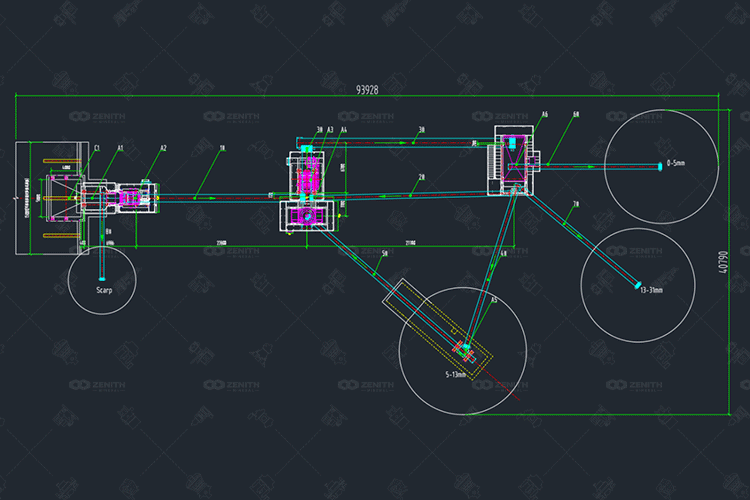
In conventional designs, the transfer stockpile and finished product stockpile are separate. Material is first transferred, then screened, then sent to finished product storage, increasing the number of stockpiles and the length of belt conveyors accordingly. In this production line, a feeding gallery is designed directly beneath the 5–13 mm finished product stockpile, allowing this stockpile to serve both as a transfer stockpile and a finished product stockpile. The material can either be sold directly as 5–13 mm finished product, or be conveyed via the SP vibrating feeder inside the gallery to the sand maker for circulating crushing and converted into manufactured sand. One stockpile serves two functions, significantly reducing the footprint and the number of belt conveyors.
The demand ratio between sand and stone in the construction market is not constant. During road construction peak seasons, demand for crushed stone is high; during concentrated concrete project periods, demand for manufactured sand rises. This production line designs the 5–13 mm aggregate as an "optional" product. When the market demands more sand, 5–13 mm material enters the sand maker through the feeding gallery for closed-circuit circulation, and the manufactured sand proportion rises. When the market demands more stone, 5–13 mm is sold directly as finished product. The same production line can adjust its product mix according to market demand at any time. An operational flexibility that ordinary two-stage crushing lines do not have.
The secondary/fine crushing and sand making modules adopt a modular design, which simultaneously reduces on-site civil works and lowers the cost of belt conveyors and cabling. At the same time, the single-machine length of belt conveyors meets the standard-length range, ensuring short delivery cycles and low investment costs. The layout between equipment reserves installation and maintenance space, so that initial installation and later maintenance do not interfere with each other.
.jpg)
This production line has now become a well-known crushing and sand making line locally. The process solution has earned wide recognition in the industry, and local clients have come to consult and learn from it, successfully leading to multiple new contracts.
The reason this process solution has earned industry recognition and been successfully replicated is that its design logic is not tailored to any one client's specific operating conditions. Rather, it covers a category of common scenarios: projects in the 100–300 TPH capacity range, with combined aggregate and sand production needs, and constraints on both budget and site footprint.
For projects of the same type, the direct reference value lies in three points: First, when the material conditions allow the use of an impact crusher, the "impact crusher + sand maker" combination for secondary and fine crushing offers a clear investment advantage over the "cone crusher + sand maker" combination, with better finished particle shape. Second, the dual-purpose finished product stockpile demonstrates that the number of stockpiles can be reduced, thereby cutting land costs to a certain extent. Third, the flexible sand-to-aggregate ratio design should be incorporated into the early planning of a production line. It determines whether the line will be able to follow market demand adjustments over the coming years.
Click Here to Get Basalt Crushing Solution
This Ethiopian basalt crushing and sand making production line controls cost through modular layout, maintains market flexibility through an adjustable sand-to-aggregate ratio design, and provides a demonstration sample — validated through multiple successful contracts for small-to-medium capacity clients with limited budgets.
ZENITH provides professional solution design, equipment supply, installation and commissioning, and after-sales service as part of its full-lifecycle services for such projects. We are also capable of delivering integrated designs covering steel structures, electrical control systems, and spare parts. If you have similar production needs, feel free to contact us for a customized solution.


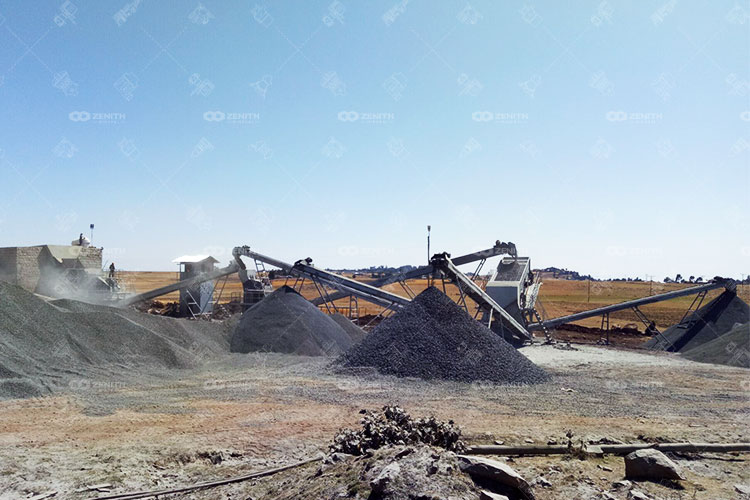
Taking the 100–300 TPH aggregate and sand combined production line custom-designed by ZENITH for an Ethiopian client as an example, this article provides a detailed analysis of how a small-to-medium capacity production line can achieve high cost-effectiveness under the constraints of limited initial investment and a restricted site footprint, and become the line offering direct reference value for the local market.
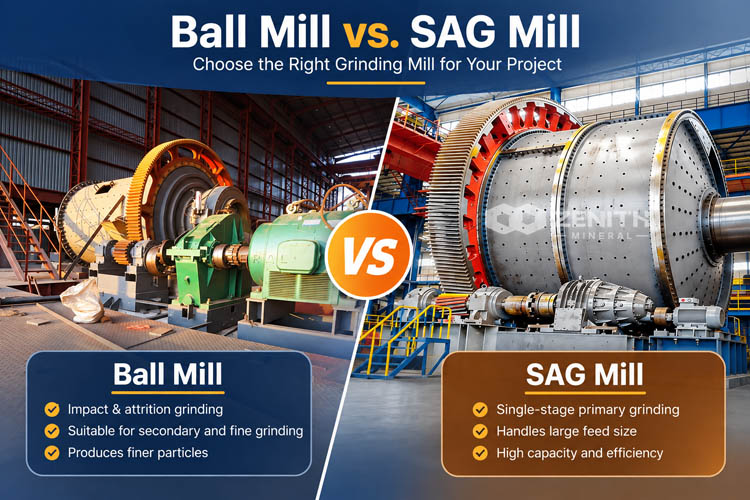
A comprehensive technical comparison of Ball mills and SAG mills for mineral grinding. Learn key differences in grinding mechanism, feed size, product fineness.
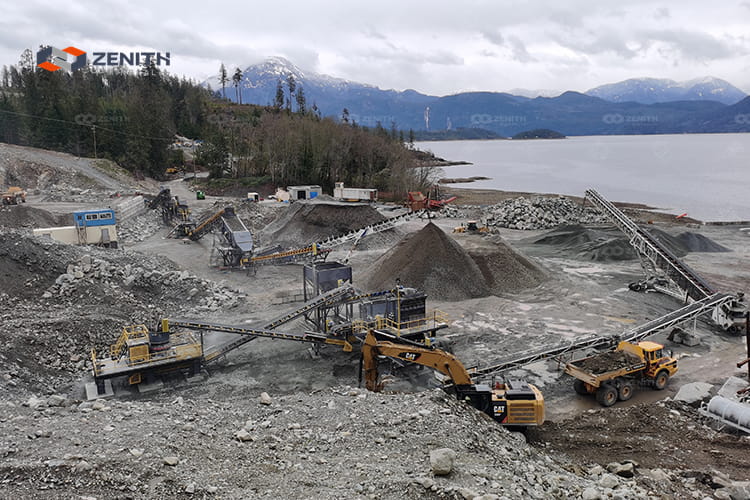
A successful aggregate production line starts with reliable rock crushing equipment and a well-engineered process design.
Fill your requirements here, and we'll send the custmized solution and quotation to you by the reserved contact information.
Copyright ©2000-2026 SHANGHAI ZENITH MINERAL CO.,LTD.

 WhatsApp



 24/7 Online