Copper Oxide Ore Leaching Plant: SX-EW Equipment & Design
With global copper prices maintaining historic highs driven by the green energy transition and electric vehicle (EV) manufacturing, mining companies are aggressively re-evaluating their assets. Previously marginalized low-grade copper oxide ores (often grading below 0.5% Cu) are now highly lucrative targets. The key to unlocking their value lies in hydrometallurgical processing—specifically heap leaching followed by solvent extraction and electrowinning (SX-EW).
This article provides a comprehensive overview of copper oxide ore leaching plant design, equipment selection, and operational considerations for mine owners seeking cost-effective, high-efficiency processing solutions.
Understanding Copper Oxide Ores
Copper oxide ores present unique challenges compared to their sulfide counterparts. These ores typically exhibit:
- Low copper grades often below 1% Cu
- High clay content that can impede solution percolation
- Alkaline gangue minerals that consume acid
- Complex mineralogy including chrysocolla, malachite, azurite, and brochantite
The refractory nature of many oxide ores requires careful processing design. However, their amenability to acid leaching makes them ideal candidates for hydrometallurgical treatment, particularly through heap leaching operations.
The Core Process: How SX-EW Works
Before selecting equipment, it is crucial to understand the three distinct phases of the hydrometallurgical process:
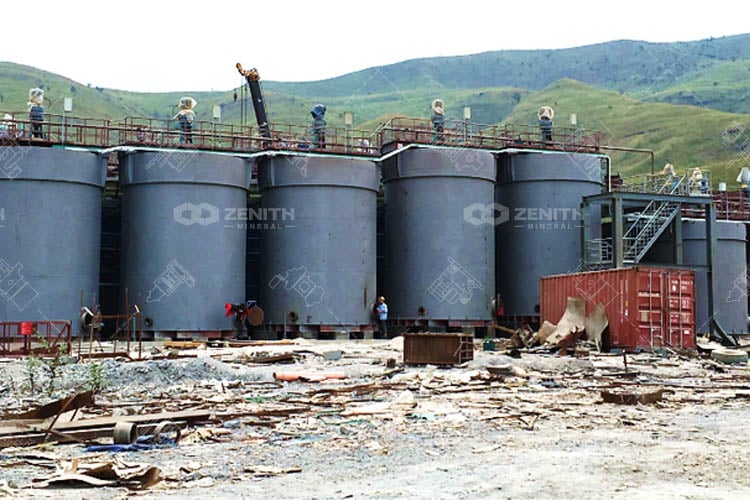
- 1. Leaching: Dilute sulfuric acid is sprayed over crushed ore heaps. The acid percolates through the rock, dissolving the copper to create a weak, impure Pregnant Leach Solution (PLS).
- 2. Solvent Extraction (SX): An organic extractant is mixed with the PLS. The extractant selectively binds to the copper ions, leaving impurities behind. The copper-loaded organic fluid is then stripped using a highly concentrated acid, creating a pure, high-grade copper electrolyte.
- 3. Electrowinning (EW): Direct electrical current is passed through the concentrated electrolyte. Pure copper (99.99%) plates onto stainless steel cathodes, ready for direct sale to the London Metal Exchange (LME) market.
While the chemistry is straightforward, the physical design and equipment selection dictate the plant's profitability.
The Crushing Circuit Design
Many mine owners mistakenly focus entirely on the chemical plant, but the success of a leaching operation is fundamentally decided in the crushing stage.
If the ore is not crushed to the optimal size, the acid cannot penetrate the rock, resulting in low recovery rates. Conversely, over-crushing generates excessive "fines" (dust-like particles), which clog the heap, cause acid pooling, and destroy permeability.
For optimal heap leaching, copper oxide ore typically needs to be crushed to a uniform size of -12mm to -19mm, depending on the porosity of the host rock.
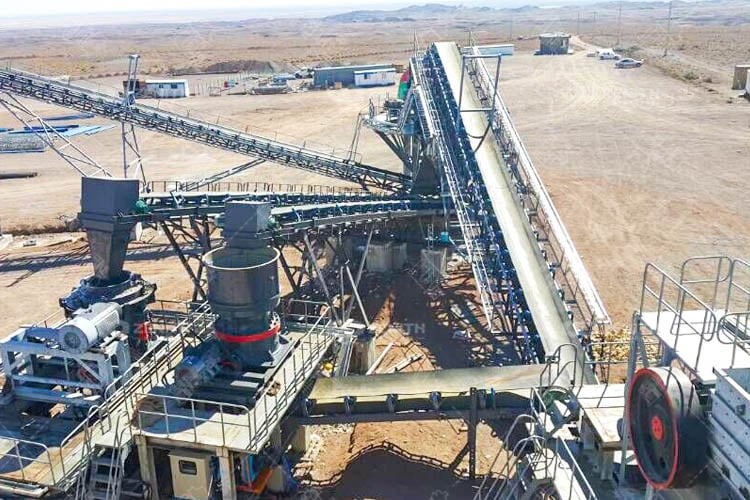
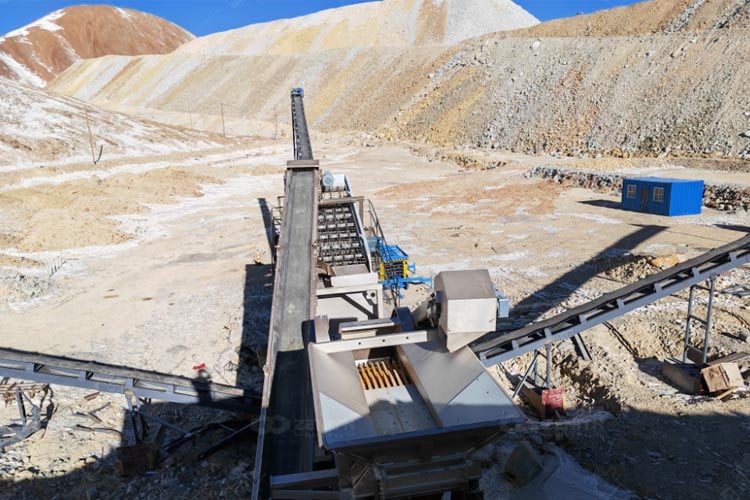
- Primary Crushing: A robust Jaw Crusher is deployed to handle the Run-of-Mine (ROM) blasted rock, reducing boulders down to manageable sizes (e.g., <150mm). For high-capacity mines, heavy-duty bolted-frame jaw crushers are preferred to minimize downtime.
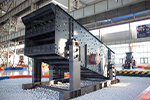
- Secondary & Tertiary Crushing: This is the most critical stage. High-efficiency Cone Crushers (such as multi-cylinder hydraulic cone crushers) operate in a closed circuit with vibrating screens. Cone crushers utilize lamination crushing principles, which produce a highly uniform, cubical particle size ideal for heap permeability.
- Agglomeration Drum: If the ore contains high amounts of clay or fine particles, it must pass through an agglomeration drum before stacking. Here, concentrated sulfuric acid and water are added to bind the fine dust to larger rocks, creating uniform "pellets." This prevents heap clogging and pre-conditions the ore for faster leaching.
Heap Pad Design and Irrigation Equipment
The leaching pad is the engine of the operation. A poorly designed pad leads to solution loss, environmental liabilities, and trapped capital.
- Pad Construction: The base must be highly engineered, typically lined with compacted clay followed by a thick High-Density Polyethylene (HDPE) geomembrane to prevent PLS from leaking into the groundwater.
- Stacking Equipment: To maintain a loose, permeable heap, bulldozers should be avoided as they compact the ore. Instead, automated Radial Stacker Conveyors or mobile track-mounted stackers are used to gently lay the ore in lifts (layers) of 3 to 8 meters high.
- Irrigation System: A network of drip emitters (wobblers or drip tubes) distributes the weak acid solution evenly over the heap. Drip irrigation minimizes evaporation in arid mining regions (like Chile, Arizona, or parts of Africa) and ensures uniform acid distribution.
The SX-EW Plant: Extracting the Value
The chemical backend transforms the liquid PLS into solid, highly valuable copper plates.
Solvent Extraction (SX) Equipment
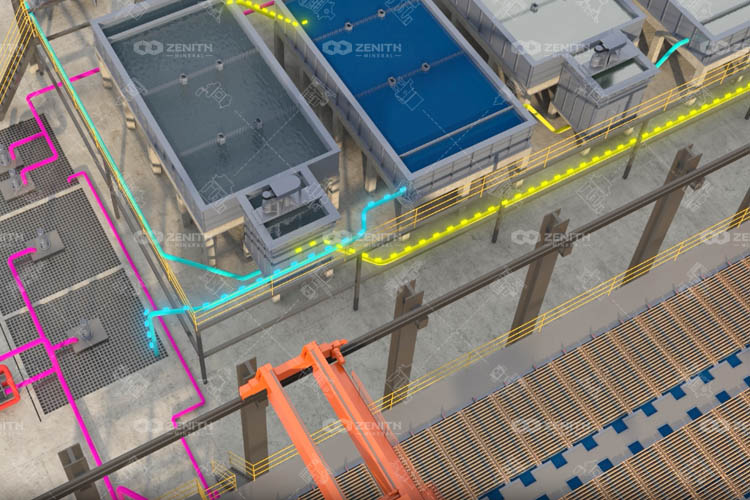
The SX plant relies on a series of Mixer-Settlers.
- In the mixer phase, massive impellers aggressively blend the aqueous PLS with the organic extractant.
- In the settler phase, the mixture flows into a large, tranquil tank where the organic and aqueous liquids naturally separate like oil and water.
- Key Design Factor: The materials used for the mixer-settlers must be highly corrosion-resistant, typically utilizing specialized FRP (Fiberglass Reinforced Plastic) or high-grade stainless steel.
Electrowinning (EW) Equipment
The EW tankhouse is the most capital-intensive and power-hungry section of the plant.
- Polymer Concrete Cells: The electrolyte flows through rows of large, acid-resistant electrolytic cells.
- Anodes and Cathodes: Lead-alloy anodes provide the positive charge, while stainless steel "blank" cathodes provide the surface for copper deposition. After 6 to 7 days, the cathodes are hoisted out, and the pure copper plates (weighing roughly 50-80kg each) are mechanically stripped.
- Rectifiers: Massive electrical rectifiers are required to convert high-voltage AC grid power into the high-amperage, low-voltage DC power required for the electro-chemical reaction.
Crucial Cost-Control Strategies for Mine Owners
To ensure a high Return on Investment (ROI), especially when dealing with low-grade ores (<0.5% Cu), operators must meticulously control their operating expenses (OPEX).
- 1. Minimize Acid Consumption: The host rock (gangue) matters as much as the copper. If the ore contains high levels of acid-consuming carbonates (like calcite), the OPEX will skyrocket. Thorough metallurgical testing is required before plant design to calculate exact acid consumption.
- 2. Optimize the Crushing Ratio: Every millimeter of crushing costs electricity and liner wear. Do not crush finer than necessary. Laboratory column leach tests will determine the exact "sweet spot" where crushing costs intersect with maximum copper recovery.
- 3. Water Balance Management: SX-EW plants are closed-loop systems, but evaporation takes a toll. Designing an efficient water recovery system and utilizing covers on PLS ponds is vital in arid regions.
- 4. Modular Plant Construction: For mid-sized mines, opting for skid-mounted or modular crushing and SX-EW units significantly reduces civil engineering costs and installation time, allowing the mine to reach cash flow months faster than a traditional stick-built plant.
The Future of Oxide Copper Processing
As high-grade copper deposits become increasingly scarce, the ability to process low-grade oxide ores efficiently will be a key competitive advantage for mining companies. The SX-EW process continues to evolve, with ongoing innovations in:
- Automation and process control for improved efficiency
- Permanent cathode technology for higher quality and productivity
- Energy optimization to reduce operating costs
- Water conservation through closed-loop solution management
For mine owners considering new oxide copper projects, the combination of well-proven technology and continued process improvements makes heap leaching with SX-EW recovery a robust, cost-effective solution for today's high-copper-price environment.



 WhatsApp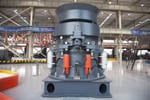

 24/7 Online