
 WhatsApp
In aggregate quarrying, mining, and concrete recycling operations, crusher wear parts and spare components represent one of the largest ongoing operational expenditures (OPEX). Every ton of crushed hard rock—whether granite, basalt, river pebble, or limestone—gradually wears down manganese liners, alloy blow bars, and internal mechanical assemblies. Selecting durable, high-wear-resistant spare parts directly impacts total cost per ton and machine uptime.
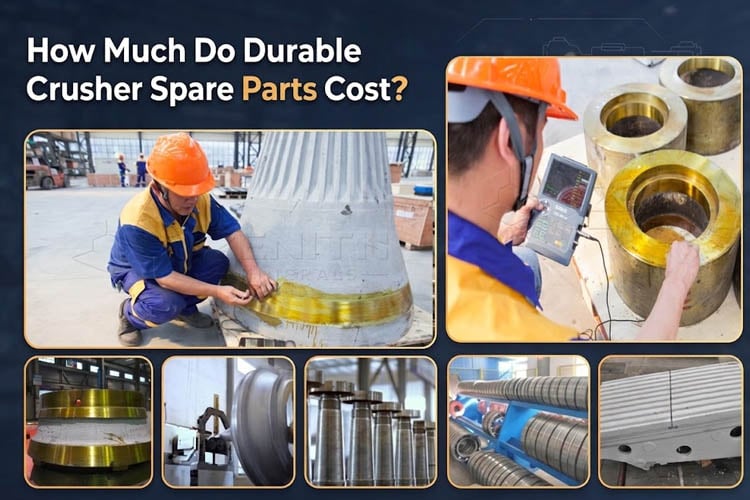
Crusher spare part costs vary significantly based on machine scale, weight, and metallurgy. A jaw plate can cost between $800 and $8,500 depending on jaw size and manganese alloy grade. A complete cone liner set (mantle and concave) ranges from $2,000 to $30,000 for high-capacity hydraulic units, while a set of high-chrome or ceramic-composite blow bars for an impact crusher can cost anywhere from $1,500 to $15,000. Although high-durability premium alloys carry a 20% to 40% higher upfront purchase price, they extend wear life by 50% to 100%, dramatically reducing your total cost per ton.
This comprehensive pricing guide breaks down costs across primary crusher types, compares wear metallurgy (Mn14, Mn18, Mn22, and TIC Inserts), details hidden replacement factors, and outlines strategies to reduce wear part spend.
Price Ranges for Crusher Spare Parts by Machine Type
Replacement parts are categorized into wear parts (components in direct contact with rock, such as liners and blow bars) and spare/mechanical parts (bearings, shafts, hydraulics, and drive gears). Below are market price estimates for durable replacement parts:
| Crusher Category | Spare Part Component | Standard Grade Cost (USD) | High-Durability Alloy/Premium Cost |
|---|---|---|---|
| Jaw Crusher | Fixed / Movable Jaw Plate (PE750 / PE900) | $800 – $1,800 | $1,200 – $2,600 (Mn18Cr2 / Mn22) |
| Jaw Crusher | Toggle Plate & Side Cheek Plates | $350 – $850 | $500 – $1,200 |
| Cone Crusher | Mantle & Concave Ring (Medium/Large) | $1,800 – $4,500 | $2,800 – $6,800 (Mn18 / TIC Insert) |
| Cone Crusher | Bronze Bushing Set & Eccentric Shaft | $1,200 – $3,500 | $2,200 – $5,500 |
| Impact Crusher | High-Chrome / Martensitic Blow Bars (Set) | $1,500 – $3,200 | $2,400 – $4,800 (Ceramic Matrix) |
| Impact Crusher | Impact Plates & Side Liner Plates | $600 – $1,500 | $950 – $2,200 |
| VSI Crusher | Rotor Tips, Distributor Cone & Anvils | $800 – $1,800 | $1,400 – $2,800 (Tungsten Carbide) |
How Metallurgy Influences Crusher Parts Durability and Price
The single biggest factor driving price differences between generic aftermarket parts and durable OEM-spec parts is steel metallurgy and heat treatment quality:
- Mn14Cr2 (Standard Manganese): Cost-effective for soft to medium-hard rock (limestone, sandstone). Poorly suited for highly abrasive quartz or granite.
- Mn18Cr2 (High-Manganese Steel): The industry standard for hard rock crushing (granite, basalt). Offers excellent work-hardening characteristics under heavy impact loading. Costs 15% to 25% more than Mn14.
- Mn22Cr2 (Ultra-High Manganese): Specially engineered for extreme impact crushing and massive rock feeds. Work-hardens rapidly under compression, extending service life by up to 30% in tough conditions.
- TIC (Titanium Carbide) Inserts: High-durability technology where hard TIC columns are embedded inside high-manganese casting walls. TIC inserts cost 35% to 50% more upfront, but increase wear life by 1.5x to 2.5x in high-abrasion silica pebble applications.
- Ceramic Composite Matrix Blow Bars: Used in impact crushers processing abrasive recycle concrete or granite. Ceramic particle reinforcement delivers superior abrasion resistance while maintaining impact toughness.
3 Hidden Costs That Affect Total Spare Part Expenditure
When budgeting for crusher spare parts, equipment owners must look beyond the initial factory FOB purchase price:
- Freight & Heavy Logistics (10% – 25% of Part Cost): Manganese jaw plates and heavy cone mantles weigh thousands of kilograms. Air freighting emergency replacement parts during sudden breakdowns incurs massive shipping premiums. Maritime container freight with planned stock management reduces logistics spend significantly.
- Unplanned Downtime Revenue Losses: A crusher idle for 3 days waiting for a replacement main shaft or bronze sleeve can lose $10,000 to $50,000+ in missed aggregate deliveries—far exceeding the cost difference of keeping an extra wear part set on site.
- Labor & Replacement Installation Time: Changing out worn liners requires crane hire, torch cutting, and skilled mechanical crews. Longer-lasting premium parts reduce replacement frequency, cutting field labor expenses over time.
4 Smart Strategies to Lower Your Wear Part Cost Per Ton
- Match Alloy to Rock Abrasion: Conduct quartz and silica content tests on your raw ore. Avoid overpaying for high-chrome blow bars if crushing soft limestone, but never use low-grade Mn14 on abrasive river pebbles.
- Perform Planned Rotating & Flipping: Periodically flip jaw plates vertically before lower teeth wear down completely. Rotate impact blow bars to utilize unused wear surfaces evenly.
- Maintain Proper Closed Side Setting (CSS): Operating a cone or jaw crusher outside recommended CSS settings creates uneven liner wear profiles, causing premature part discard while usable metal remains.
- Keep On-Site Critical Spares: Always maintain a safety stock of high-wear items (jaw plates, blow bars, mantles, seal rings) inside a dry storage container at the quarry site.
Where Can You Buy Durable Crusher Spare Parts?
To ensure maximum equipment uptime and precise mechanical fitting, aggregate quarry owners and mining operators generally source replacement components through three main channels:
- Original Equipment Manufacturers (OEMs): Offer exact dimensional fits, but often come with high price premiums and lengthy lead times.
- Third-Party Aftermarket Suppliers: Provide lower initial purchase costs, but require strict independent verification of metallurgy and casting precision to avoid early failure.
- Integrated Machinery & Casting Manufacturers: Direct manufacturers that build both complete crushing plants and high-durability wear components. This option delivers OEM-level precision alongside factory-direct cost efficiency.
Premium Crusher Wear Parts & Global Support from ZENITH
At ZENITH, we manufacture high-precision, long-life crusher wear parts engineered specifically for demanding jaw, cone, and impact crushing applications. Our wear components are produced according to strict quality standards:
- Premium Manganese Steel Alloys: High-grade Mn18%Cr2 and ultra-high Mn22%Cr2 formulations, plus optional Titanium Carbide (TIC) inserts and ceramic composites for extreme silica abrasion.
- Precision Casting & Inspection: Advanced foundry casting processes verified through 100% X-ray non-destructive testing and ultrasonic quality inspection to prevent internal flaws.
- Strict Dimensional Tolerances: Machined to precise dimensional tolerances within 2 mm for seamless OEM-spec replacement and fast field installation.
- Global Delivery & Regional Support: Fast international container shipping backed by strategic regional spare parts inventories to eliminate costly site downtime.
Need a Factory-Direct Spare Parts Quotation? Contact our technical parts team today with your machine model or drawing numbers to receive an itemized quote and custom metallurgy recommendation.
FAQs About Stone Crusher Spare Parts Cost
Q1: How much do jaw crusher plates cost?
A set of jaw plates (fixed and movable) ranges from approximately $800 for compact crushers up to $15,000 for large primary mining crushers . The average wear cost per ton of processed material typically ranges between $0.05 and $0.20.
Q2: How much do cone crusher liners cost?
Individual mantle or bowl liners range from $1,200 for small units to $28,000 for large-scale mining cones or premium TIC-inserted alloys. A complete liner set (mantle plus bowl liner) for a medium-to-large cone crusher typically costs between $6,500 and $17,000, with a wear cost averaging $0.08 to $0.25 per ton.
Q3: How much do impact crusher blow bars cost?
A full set of blow bars (3 or 4 bars per set) ranges from $1,500 for small impactors to $15,000 for heavy-duty ceramic-composite units. Wear cost per ton varies widely from $0.10 to $0.50 depending directly on the silica content and abrasiveness of the feed material.
Q4: How long do durable crusher spare parts last?
Component service life depends heavily on rock hardness, silica abrasiveness, and feed size. As a general industry benchmark for high-durability alloys: jaw plates last 1,000–2,500 operating hours, cone liners last 800–2,500 hours, and impact blow bars last 200–1,000 hours.
Q5: Is it worth buying premium crusher wear parts?
In most hard rock applications, yes. Premium parts typically cost 20–40% more upfront but deliver 50–100% longer life, resulting in lower cost per ton and less downtime. The exception is low-abrasion, low-capacity operations where standard parts may be adequate.


 24/7 Online