
 WhatsApp
In the global construction and infrastructure sector, aggregate production is the backbone of development. Whether it is for high-strength concrete, asphalt road base, or railway ballast, the quality of the final stone product is dictated by the efficiency of the crushing circuit.
Choosing the right crusher for an aggregate application is not merely about buying a machine; it is about designing a high-yield system that balances mineralogy, throughput, and final product specifications. This article serves as a professional technical guide for quarry owners and project managers to navigate the selection process.
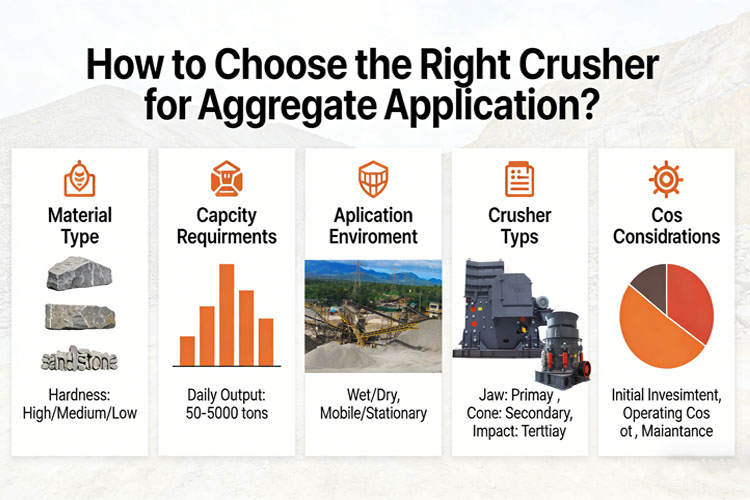
Analyze Your Feed Material
The first step in selection is a cold, hard look at the rock you are processing. No two quarries are identical, and "general-purpose" machines often lead to specialized failures.
- Hardness and Abrasiveness: This is the most critical differentiator. For hard, abrasive rocks like granite, basalt, or quartzite, a compressive crushing method is required. Using an Impact Crusher on these materials would result in astronomical wear-part costs. Conversely, for soft, non-abrasive materials like limestone or gypsum, an impactor provides a much higher reduction ratio for a lower initial investment.
- Moisture and Plasticity: If your feed material contains high clay content or moisture (common in tropical regions), a standard crusher may "choke." In these cases, you must select a crusher with a wide discharge opening or integrate a Vibrating Grizzly Feeder with a scalping deck to remove fines and sticky soil before they enter the crushing chamber.
- Maximum Feed Size: A common mistake is undersizing the primary crusher. Your jaw crusher’s "gape" should be at least 20% larger than the maximum dimensions of your blasted rock to ensure a steady "bite" and prevent bridging.
Read Also:Materials Crushing Processes: Limestone, Granite, and Basalt
Define Your Final Product Requirements
What do you intend to sell? The end-use of your stone dictates the machinery.
- Product Size (Gradation): If you need multiple sizes (e.g., 0-5mm, 10-20mm, 20-40mm), you will likely need a three-stage crushing plant (Primary, Secondary, and Tertiary).
- Product Shape (Cubicity): For high-quality concrete and asphalt aggregates, "flaky" or "elongated" stones are rejected. Impact Crushers and VSI (Vertical Shaft Impact) crushers are superior at "shaping" rock into cubes compared to compressive crushers like jaws.
Comparing the Crusher Technologies
| Crusher Type | Best Stage | Ideal Material | Typical Materials | Key Advantage |
|---|---|---|---|---|
| Jaw Crusher | Primary | Hard & Abrasive | Granite, Basalt, Quartzite, Iron Ore, River Stone | Reliable, handles large feed, low maintenance cost. |
| Cone Crusher | Secondary | Hard & Abrasive | Granite, Diabase, Pebble, Iron Ore, Copper Ore | Consistent output size, high efficiency in hard rock, lower wear cost. |
| HSI Crusher (Impact) | Primary / Secondary | Soft to Medium Hard | Limestone, Gypsum, Coal, Concrete Recycling, Dolomite | High reduction ratio, excellent cubicity (superior product shape). |
In aggregate applications where sand is the primary product, a VSI is often the "final touch." Known as a "Sand Maker," the VSI uses rock-on-rock crushing to shape the material and create high-quality fines that meet strict building codes.
Capacity and Throughput
Calculate your required Tons Per Hour (TPH) based on your daily sales targets, but always build in a safety margin.
- The 80% Rule: A crusher should never be expected to run at 100% of its theoretical capacity. Professional plant designs aim for a "sweet spot" at 75% to 80% of the machine's maximum rating to allow for fluctuations in feed size and density.
- Closed-Circuit vs. Open-Circuit: Choosing a closed-circuit design (where oversized material is returned to the crusher via a screen) ensures 100% product sizing accuracy, which is essential for high-spec aggregate applications.
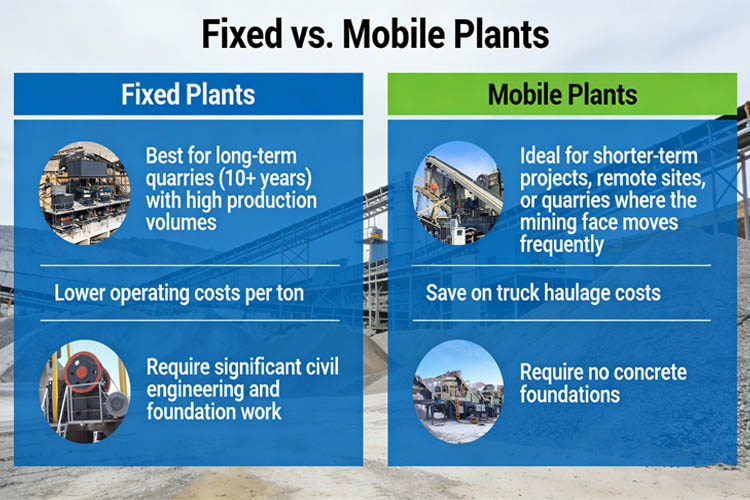
Operational Environment: Fixed vs. Mobile Crusher
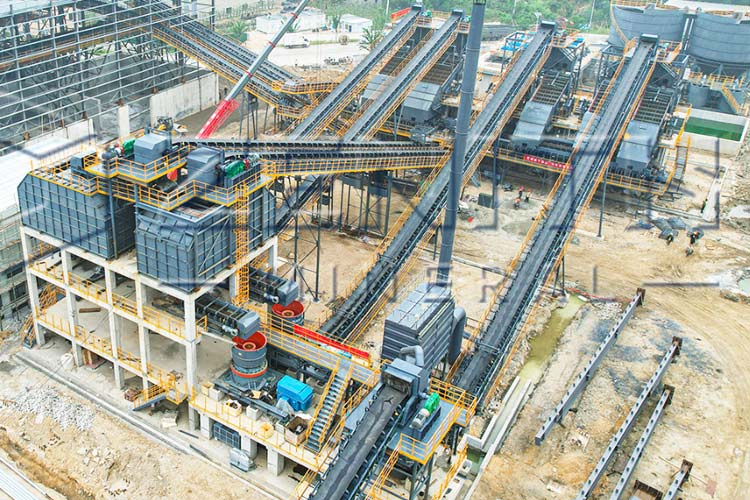
- Fixed Plants: Best for long-term quarries (10+ years) with high production volumes. They offer lower operating costs per ton but require significant civil engineering and foundation work.
- Mobile Plants: Ideal for shorter-term projects, remote sites, or quarries where the mining face moves frequently. They save on truck haulage costs and require no concrete foundations.
Total Cost of Ownership (TCO)
The cheapest crusher at the time of purchase is often the most expensive over a five-year period. A professional selection process includes an analysis of:
- 1. Wear Parts Life: Request the Bond Abrasion Index testing for your rock. This tells you how often you will need to replace jaw plates or mantles.
- 2. Energy Efficiency: Power is the largest recurring cost. Modern crushers with high-efficiency motors and optimized crushing chambers can reduce $kW$ per ton significantly.
- 3. Ease of Maintenance: In a quarry, downtime is lost revenue. Look for features like hydraulic adjustment systems and automated lubrication, which reduce manual labor and prevent catastrophic bearing failures.
Selecting the right crusher for an aggregate application is a balance of geological science and economic strategy. By matching your crusher technology to your rock's hardness, focusing on the cubicity of your final product, and choosing a configuration that offers the lowest total cost of ownership, you turn a machine into a profit engine.
At the end of the day, the aggregate market doesn't just pay for crushed stone—it pays for consistency. The right crusher ensures you deliver that consistency every time the belt runs.


 24/7 Online