
 WhatsApp
In the Philippines, local sand and aggregate raw materials are dominated by river pebbles. This differs from most mining projects that require drilling and blasting: river pebbles are formed through long-term river transport, washing, and rounding, with continuous gradation and naturally rounded shapes. The raw material naturally contains a considerable proportion of small-size aggregate and manufactured sand feed that can be sold directly as finished products, while the pebble surfaces are typically coated with riverbed silt and clay.
These characteristics determine that the starting point of river pebble crushing plant design is not "how to crush," but "what doesn't need to be crushed." If the "crush-before-screen" process of mined raw materials were copied directly, the finished products already present in the feed would be crushed repeatedly, wasting crushing capacity, accelerating wear parts consumption, and breaking naturally rounded aggregate, which could be sold directly, into flaky and elongated particles. Product quality would decline rather than improve. The correct approach is: screen before crushing.
The 200–250 TPH river pebble crushing plant designed by ZENITH for its Philippine client is the complete implementation of this "screen-before-crush" approach, and its design has become the standard configuration for similar projects in the Philippines.
Get River Pebbles Crushing Solution
.jpg)
I. Raw Material Characteristics and Design Principles
· Raw material processed: River pebbles
· Feed size: 0–630 mm, continuous gradation
· Design capacity: 200–250 TPH, stationary installation
· Product specifications: 0-5-10-20-38 mm
· Quality standards: Manufactured sand (0–5mm) complies with ASTM C33 requirements for fine aggregate. All other coarse aggregates meet ASTM C33 specifications for coarse aggregate, conforming to Philippine concrete engineering standards.
In the overall design of the production line, two factors derive directly from the raw material characteristics and determine the form of the entire line:
The feed contains finished product. River pebbles have completed natural classification during natural transport. A considerable portion of the feed is already at qualified particle sizes. The design must allow this material to bypass the crushers and enter the screening stage directly. This is both a saving of crushing capacity and a protection of finished product quality.
The raw material contains clay. Pebbles extracted from riverbeds have silt and clay adhering to their surfaces. Dry-process screening is highly prone to screen blinding, and finished product cleanliness can hardly meet standards. Therefore, the project adopts a wet-process production, with sand washing equipment configured at the screening stage, allowing desliming and classification to be completed simultaneously.
Click Here to Get River Pebbles Crushing Solution
II. Screen Before Crushing: How Small Material Bypasses the Crushers
The feeding stage of this production line performs the first screening function.
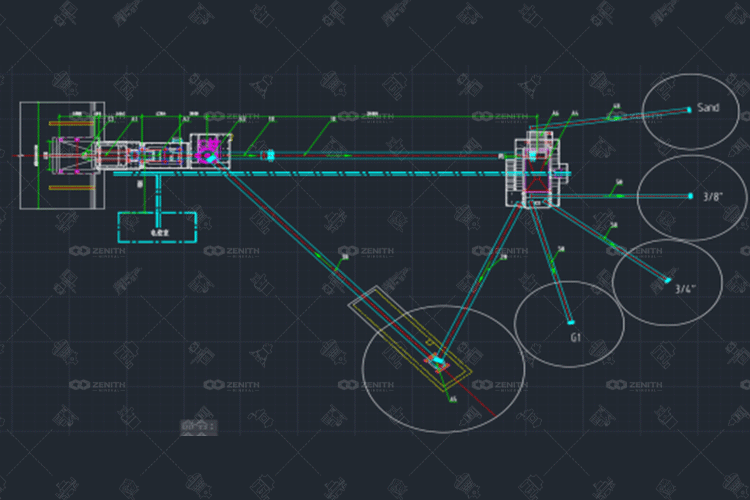
River pebbles are dumped by dump truck into the raw material bin, then conveyed continuously and steadily by the ZENITH F5X vibrating feeder to the PE jaw crusher for primary crushing. The key design lies in the feeder's discharge hopper: the small material and finished products in the feed that already meet the size requirements slide directly from the feeder's discharge hopper onto the main belt conveyor, merging with the jaw crusher discharge, and together enter the finished product screen for screening.
This is the physical realization of "screen before crushing" that the qualified material naturally present in the raw material passes through no crusher at all.
Compared with the conventional "crush-before-screen" process, this brings threefold benefits:
1. The effective capacity of the jaw crusher and cone crusher is fully devoted to the large material that genuinely needs crushing, allowing more economical equipment specifications at the same capacity.
2. Crusher load is reduced, and wear parts consumption decreases accordingly.
3. Naturally rounded small-size aggregate is no longer crushed into angular particles, but enters the market directly as premium finished product.
III. Crushing Module: The Jaw Crusher + Cone Crusher Combination
The crushing module consists of the F5X vibrating feeder, PE jaw crusher, and HPT cone crusher.
Click Here to Get River Pebbles Crushing Solution
Primary crushing is completed by the jaw crusher, handling the large river pebbles not bypassed at the feeding stage. Secondary and fine crushing is undertaken by the cone crusher, a selection that directly related to the material characteristics of river pebbles: the main mineral composition of river pebbles is high in hardness and highly abrasive. Blow-bar-type wear parts under the impact crushing principle are consumed extremely quickly on such material. Cone crushers adopt the inter-particle compression crushing principle. Material is crushed by compression between the concave and mantle and their wear parts offer good adaptability to highly abrasive materials with long service life. For hard, abrasive materials like river pebbles, jaw crusher primary crushing + cone crusher secondary and fine crushing is a mature combination widely used in the industry.
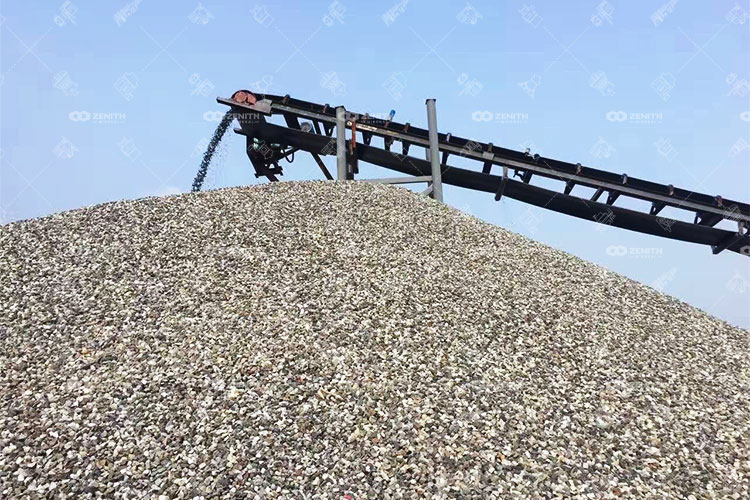
The crushed material enters the finished product screen through one main belt conveyor for screening: 0–5 mm finished sand, after washing, is conveyed together with the 5–10 mm, 10–20 mm, and 20–38 mm fractions by the finished product belts to the stockpiles; material larger than 31.5 mm is conveyed to the transfer stockpile to await return to the cone crusher, forming a closed-circuit crushing loop that ensures all final products meet the required specifications.
IV. Screening and Sand Washing Module: Where the Wet Process Delivers
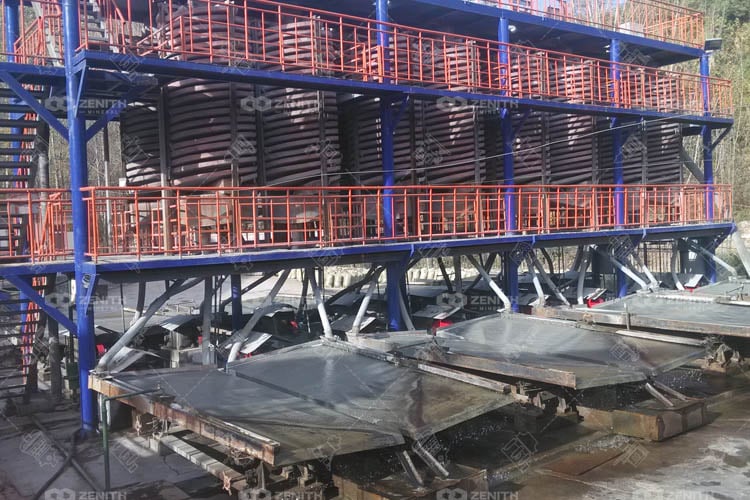
The screening and washing module are equipped with one ZENITH S5X vibrating screen and one XSD sand washer — the execution core of the wet process.
Click Here to Get River Pebbles Crushing Solution
Screening handles the classification of multiple finished product sizes; the sand washer addresses the critical process step for clay-bearing raw material — the 0–5 mm manufactured sand is washed to remove surface-adhered silt and fines before joining the various crushed stone fractions in the finished product stockpiles. For construction sand, clay content is one of the core indicators. Wet sand washing is the most direct and effective process route for handling clay-bearing river pebble raw material. Meanwhile, washed manufactured sand, with its performance in gradation and cleanliness, more easily meets the requirements for high-grade concrete sand.
The production line ultimately forms an integrated structure of "crushing module + screening and washing module + finished products."
V. Linking the Entire Line with Three Main Belt Conveyors
Thanks to the screen-before-crush design and modular layout, the entire closed-circuit crushing system of this production line is linked using only three main belt conveyors.
In a conventional arrangement, the feeding, primary crushing discharge, secondary/fine crushing feed, screening return, and finished product conveying each have their own independent belt conveyors, and the count often multiplies. This production line compresses the conveying system investment to the simplest possible form through the small-material bypass chute (eliminating one feeder branch conveyor), centralized equipment arrangement (shortening and merging conveying paths), and the electrical control room positioned directly beneath the main energy-consuming equipment (shortening cable runs).
This "simplified" design has proven very popular in the local market, and has made this solution the standard configuration for river pebble projects in the Philippines.
Conclusion
The design wisdom of river pebble projects lies in: recognizing the aggregates already present in the raw material — "screen before crushing" — and letting them bypass the crushers and go straight to market; recognizing the highly abrasive nature of the material and replacing impact crushing with the inter-particle compression crushing of a cone crusher; recognizing the clay-bearing reality of the raw material and using wet-process sand washing to ensure finished product cleanliness. The 200–250 TPH river pebbles crushing plant designed by ZENITH for its Philippine client fully embodies this design wisdom.
ZENITH provides complete equipment sets and integrated line design capability for river pebble projects. If your raw material is dominated by river pebbles, feel free to contact us for a customized process solution.
Click Here to Get River Pebbles Crushing Solution




 24/7 Online