
 WhatsApp
Crushed stone and gravel are two of the most widely used construction aggregates. They form the foundation of roads, buildings, drainage systems, and landscaping features across the world. Yet, many contractors, quarry operators, and homeowners struggle with a fundamental question: What size stone do I actually need?
Choosing the wrong rock sizes not only wastes money but can lead to driveway washouts, drainage failures, or unstable foundations. This guide will explain the difference between crushed stone and gravel, provide a clear reference to ASTM standard sizes (#57, #411, #8, and more), and show you exactly which material to choose for your specific project.
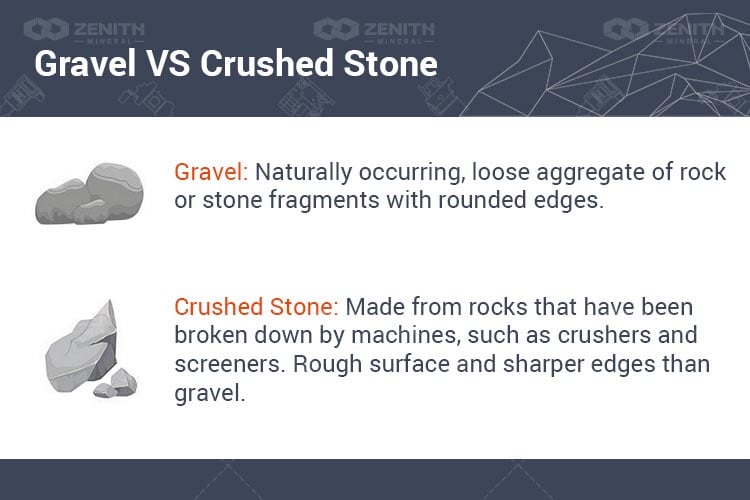
Part I: Crushed Stone vs. Gravel – What Is the Difference?
Crushed Stone (Manufactured Aggregate)
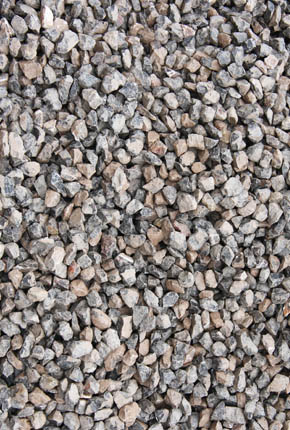
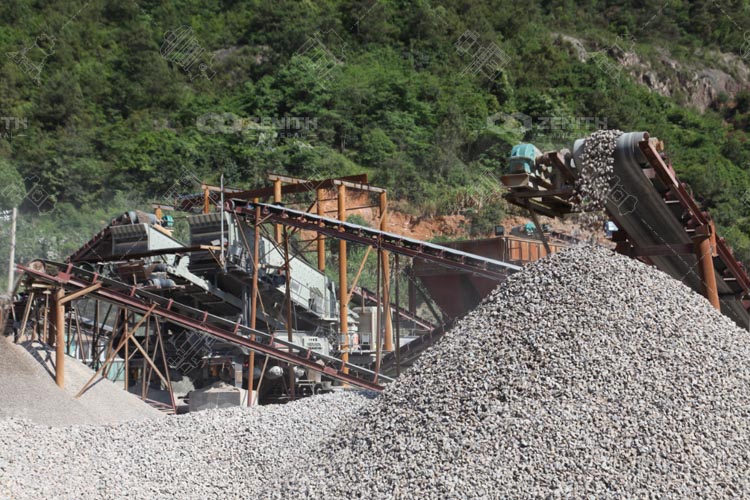
Crushed stone, also known as manufactured aggregate, is produced by blasting raw rock blocks and breaking them via industrial crushers including jaw crushers, cone crushers and impact crushers.
Raw rock sources include limestone, granite, basalt, dolomite and discarded construction concrete. After multi-stage crushing and vibrating screening, we get uniform, angular stone fragments with sharp interlocking edges. It follows strict ASTM C33 grading standards for structural construction use.
Key Characteristics:
- Angular, sharp edges with rough surfaces
- Excellent interlocking ability when compacted
- Highly uniform particle sizes after screening
- Available in precise ASTM grades
Gravel (Natural Aggregate)
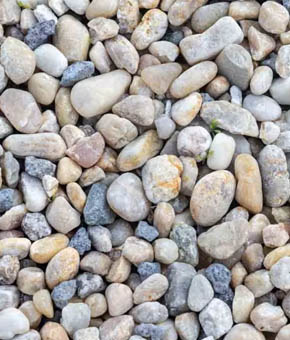
Gravel refers to naturally formed loose rock fragments shaped by long-term river erosion, glacial weathering or sediment deposition. It features smooth, rounded surfaces without mechanical crushing. Common sources include riverbeds, lake banks and coastal zones, with inconsistent particle sizes mixed naturally without standardized screening.
Key Characteristics:
- Rounded, smooth surfaces (like marbles)
- Poor interlocking – tends to shift under load
- Sizes vary naturally by source
- Superior drainage due to larger gaps between stones
Comparison Summary
| Feature | Crushed Stone (Manufactured Aggregate) | Natural Gravel |
|---|---|---|
| Source | Mechanically crushed virgin rock or waste concrete | Natural river/glacial sediment deposits |
| Shape | Angular, sharp edges, rough surface | Smooth, fully rounded pebbles |
| Interlocking | Excellent; tight compaction under load | Poor; stones slide easily under heavy weight |
| Drainage | Good (depends on gradation) | Outstanding large voids for rapid water flow |
| Consistency | Fully controllable via screening, meets ASTM C33 | Irregular mixed sizes without fixed grading |
| Best Use | Road base, concrete mixing, building foundation, heavy infrastructure | Landscaping, decorative paths, French drain filler |
| Recyclable | Recycled crushed concrete aggregate available | Rare recycled natural gravel |
The critical takeaway: If you need a stable, compacted base, choose crushed stone. If you need excellent drainage or a decorative finish, gravel may be the better choice.
Part II: The ASTM Crushed Stone Size Guide
In the United States, crushed stone and gravel are graded according to the ASTM C33 standard. Knowing these standard grades is essential for purchasing the correct material. Below is a comprehensive breakdown of the most common ASTM sizes, their particle dimensions, and their primary applications.
1. Coarse Aggregates – The Heavy Lifters
Coarse aggregates are the largest crushed stone grades, typically ranging from 1 inch to over 4 inches in size. These are the "heavy lifters" of the aggregate world, used where maximum strength and load-bearing capacity are required.
#1 Stone measures between 2 and 4 inches (approximately 50 to 100 millimeters). This is about the size of a fist or a large mango. #1 stone is used primarily for heavy road base construction, erosion control along shorelines and embankments, and large-scale drainage structures where maximum water flow is needed.
#3 Stone ranges from 1/2 inch to 2 inches (12 to 50 millimeters), similar in size to a tennis ball or an egg. This grade is commonly specified for railroad ballast, heavy drainage system bases, and as the foundational base layer for driveways before the surface material is applied.
#4 Stone is slightly smaller, at 1 to 1.5 inches (25 to 38 millimeters), roughly the size of a golf ball. It is used for heavy-duty drainage applications and as bedding material for large-diameter pipes.
2. Medium Aggregates – The Workhorses
Medium aggregates are the most commonly used grades in construction. They are versatile, easy to work with, and form the backbone of most concrete, asphalt, and drainage projects.
#57 Stone is the most widely used crushed stone grade in North America. It measures 3/4 inch (9.5 to 25 millimeters), about the size of a quarter or nickel. This is considered a "clean stone," meaning it has been washed and contains no fine dust or particles. #57 stone is the gold standard for drainage applications, particularly in French drains where water must flow freely through the gaps. It is also extensively used as aggregate in concrete and asphalt production and as a stable base layer for various construction projects.
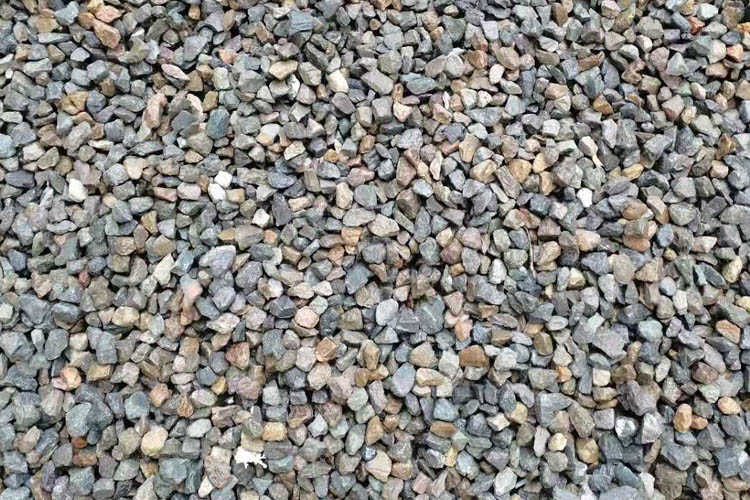
#57 Stone
#67 Stone is similar to #57 but slightly smaller, measuring 3/4 inch and under (less than 19 millimeters). It is often used for concrete slab bases, road construction, and highway projects where a slightly finer aggregate than #57 is required while still maintaining good drainage characteristics.
3. Fine Aggregates – Leveling and Filling
Fine aggregates are the smallest crushed stone grades, used for filling voids, leveling surfaces, and creating smooth finishes.
#8 Stone ranges from 1/8 to 3/8 inch (5 to 9.5 millimeters) – about the size of a pea, but with angular edges. This grade is commonly used in concrete mixes and asphalt production. It is also popular as a decorative landscaping stone and serves as an excellent leveling course for paving stones and concrete slabs.
#10 Stone, also known as stone dust or screenings, consists of particles smaller than 5 millimeters – similar in texture to coarse sand. It is used as a base for paving stones, as an ingredient in concrete block production, and is the fine component mixed with #57 stone to create crusher run (#411).
4. Mixed Aggregates – The Driveway King
Mixed aggregates combine coarse and fine materials to create a compactable, stable surface ideal for driveways and load-bearing areas.
#411 Stone, often called crusher run or quarry process, is a blend of #57 stone and #10 stone dust. The larger stones provide the structural skeleton, while the fine dust fills the voids between them. When this mixture is wet and properly rolled, it compacts to a surface nearly as hard and stable as concrete. This makes #411 the best choice for driveway surfaces, parking pads, and construction foundations where a stable, non-shifting surface is required.
Complete ASTM Crushed Stone Size Reference Table
| ASTM Grade | Particle Size | Primary Applications |
|---|---|---|
| #1 | 2 – 4 inches (50 – 100 mm) | Heavy road base, erosion control, large drainage structures |
| #3 | 1/2 – 2 inches (12 – 50 mm) | Railroad ballast, drainage system base, driveway base layer |
| #4 | 1 – 1.5 inches (25 – 38 mm) | Heavy-duty drainage, large pipe bedding |
| #57 | 3/4 inch (9.5 – 25 mm) | Drainage (French drains), concrete & asphalt aggregate, base material |
| #67 | 3/4 inch and smaller (<19 mm) | Concrete slab base, road construction, highway projects |
| #8 | 1/8 – 3/8 inch (5 – 9.5 mm) | Concrete mixes, asphalt, decorative landscaping, leveling course |
| #10 | Stone dust / screenings (<5 mm) | Paver base, concrete blocks, component of crusher run |
| #411 | Mix of #57 + #10 stone dust | Driveway surfaces, parking pads, stable compacted base |
Part III: Common Types of Gravel & Their Applications
While crushed stone is man-made and engineered for specific size and shape, natural gravel is formed over thousands of years by the forces of water, wind, and ice. Natural gravel is prized for its aesthetic appeal, natural color variations, and excellent drainage properties. Unlike crushed stone, gravel particles are typically rounded and smooth, which makes them more comfortable to walk on and visually pleasing for landscaping.
Below is a detailed breakdown of the most common natural gravel types and their best uses.
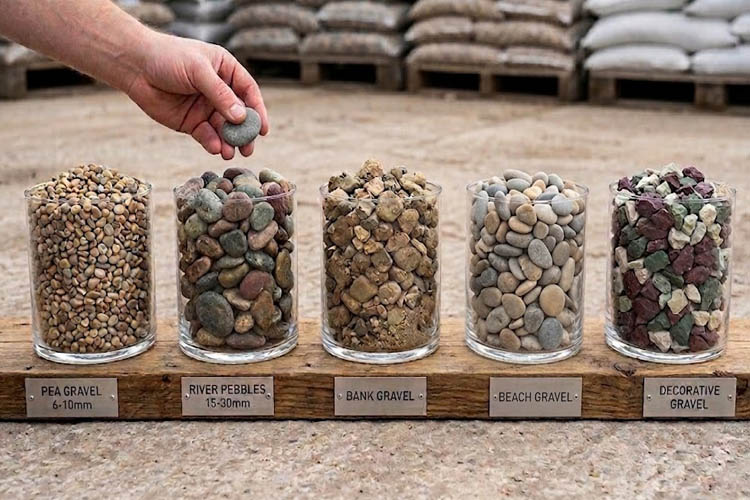
1. Pea Gravel
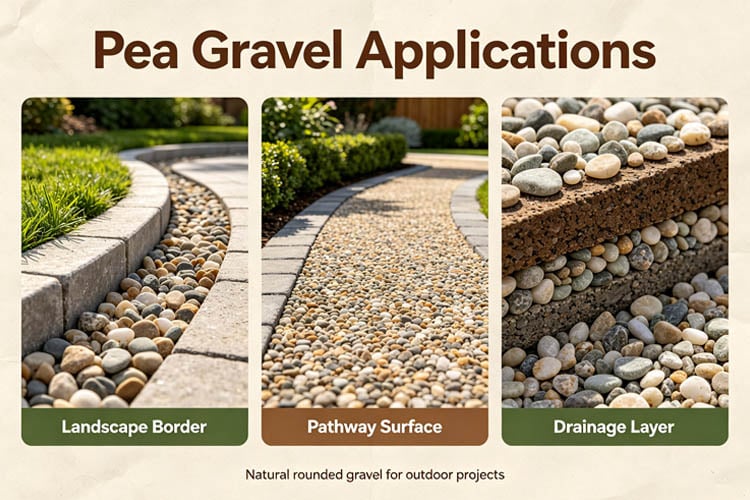
Pea gravel is one of the most popular and recognizable types of natural gravel. It consists of small, smooth, rounded stones, typically measuring about 3/8 inch (approximately 9.5 millimeters) in diameter – roughly the size of a pea. The stones are usually found in a mix of natural colors, including brown, gray, white, and tan.
Key Characteristics: Pea gravel is smooth and comfortable underfoot, making it a popular choice for pathways and recreational areas. It provides excellent drainage and does not compact, which means it remains loose and easy to move. However, because it does not lock together, it is not suitable for high-traffic vehicular areas or driveways.
Primary Applications:
- Garden pathways and walkways
- Playground surfaces and dog runs
- Mulch for flower beds and planter boxes
- Drainage fill around foundations and pipes
- Decorative ground cover in rock gardens
2. River Pebbles (River Rock)
River pebbles are larger, smoother stones naturally shaped by the flow of rivers and streams over centuries. They typically range from 1 to 6 inches (approximately 25 to 150 millimeters) and come in a wide range of natural earth tones, including gray, brown, tan, and reddish hues.
Key Characteristics: River pebbles are exceptionally smooth and polished by water action. They are highly decorative and provide a natural, premium look to landscaping projects. Their larger size makes them stable and resistant to displacement. However, they are heavier and more expensive than pea gravel.
Primary Applications:
- Dry creek beds for drainage and erosion control
- Decorative water features and pond surrounds
- Landscape accent borders and rock gardens
- Ground cover in xeriscaping (low-water landscaping)
- Retaining wall backfill where aesthetic appeal is important
3. Bank Gravel (Bank Run Gravel)
Bank gravel, also known as bank run gravel, is an unprocessed, natural mixture of gravel, sand, and clay or silt. It is typically excavated directly from glacial deposits or riverbanks with minimal processing. The particle sizes can vary widely, from fine sand to stones up to several inches in diameter.
Key Characteristics: Bank gravel is the most economical and readily available gravel type. It is not washed or screened, so it contains a significant amount of fine material. This mix of particle sizes makes it ideal for creating a stable, compactable base, but the clay content can cause drainage issues in some applications.
Primary Applications:
- Large-scale fill projects and embankment construction
- Road sub-base in low-traffic areas
- Temporary access roads for construction sites
- Filling land depressions and leveling ground
- Base material for foundations in non-critical applications
4. Beach Gravel (Sea Gravel)
Beach gravel, also called sea gravel, is formed by the constant tumbling action of ocean waves. This process produces stones with very smooth surfaces and highly polished appearances. The stones range in size but are generally small to medium, often in shades of white, gray, cream, and soft pastel colors.
Key Characteristics: Beach gravel offers premium aesthetic value, making it ideal for high-end landscaping and architectural projects. However, salt residue from ocean water can be harmful to concrete and plants, so beach gravel must be thoroughly washed with fresh water before use if it will come into contact with concrete or soil.
Primary Applications:
- Premium landscape designs and decorative displays
- Zen gardens and indoor planters
- Pathways in coastal or beach-themed landscaping
- Architectural accents and interior decoration
- Use in aquariums and terrariums (after proper washing)
5. Decorative Gravel (Specialty Types)
Decorative gravel includes a variety of specialty stones selected primarily for their color, texture, or visual impact. Common types include:
- Crushed Marble Chips: White, bright, and reflective stones used for pathways, rock gardens, and decorative borders. They can be angular, providing a different look from rounded gravel.
- Lava Rock: Lightweight, porous, and available in red, black, or brown. Retains heat and is often used as mulch in xeriscaping or around plants to retain soil moisture.
- Slate Chips: Thin, flaky stones in deep gray, blue, or green hues. Used for decorative pathways, dry creek beds, and modern landscape designs.
- Granite Gravel: Durable, naturally speckled stones in gray, pink, or white. Offers a refined, elegant appearance for driveways and paths.
Key Characteristics: Decorative gravels are chosen for aesthetics first and function second. They often carry a higher price tag than conventional gravel but can significantly enhance a property's visual appeal.
Primary Applications:
- Ornamental garden features and focal points
- Pathways and patios in high-end landscaping
- Ground cover around plants to prevent weeds
- Interior design features and decorative displays
- Driveways where appearance is as important as function
Complete Natural Gravel Reference Table
| Gravel Type | Particle Size | Key Characteristics | Primary Applications |
|---|---|---|---|
| Pea Gravel | ~3/8 inch (9.5 mm) | Small, smooth, rounded; comfortable underfoot; excellent drainage | Garden paths, playgrounds, drainage fill, decorative ground cover |
| River Pebbles | 1 – 6 inches (25 – 150 mm) | Large, smooth, polished; natural earth tones; highly decorative | Dry creek beds, water features, accent borders, rock gardens |
| Bank Gravel | Variable, sand to stones | Unprocessed mix of gravel, sand, clay; economical; compactable | Fill projects, embankments, road sub-base, temporary access roads |
| Beach Gravel | Small to medium | Smooth, polished; premium aesthetic; may contain salt residue | High-end landscaping, decorative planters, architectural accents |
| Decorative Gravel (Marble, Lava, Slate, Granite) | Variable | Chosen for color, texture, or visual impact; premium pricing | Ornamental gardens, pathways, ground cover, driveways |
Part IV: How to Choose the Right Stone for Your Project
Selecting the correct aggregate ensures your project's durability, reduces maintenance costs, and prevents structural failure. Here is a practical, application-based guide.
Driveway Projects
- Base Layer (underneath the surface): Use #3 or #4 crushed stone. The larger rock sizes provide the load-bearing strength needed to support vehicle traffic on unstable soil.
- Surface Layer (the top you drive on): Use #411 (Crusher Run / Quarry Process). The mixture of #57 stone and stone dust compacts to a hard, stable, and dust-free surface that will not shift under tires.
- Decorative or Light-Use Driveway: Use Pea Gravel or decorative granite gravel. These offer a pleasing appearance, but they will not compact into a hard surface and require regular raking to keep smooth.
Drainage & Erosion Control
- French Drain / Trench Drain: Use #57 washed crushed stone. It must be clean (washed). Stone dust or fines will clog the drain pipe and reduce water flow.
- Drainage System Base or Heavy Water Flow: Use #3 crushed stone. Its larger size allows water to move rapidly, making it suitable for stormwater management and large drainage structures.
- Erosion Control (Slopes, Shorelines): Use #1 stone or large river pebbles. Their weight and size resist movement from water runoff, stabilizing embankments.
- Decorative Dry Creek Bed: Use river pebbles (1–4 inches). They create a natural-looking channel that blends with landscaping while managing water flow.
Foundations & Paving
- Patio or Paver Base: Use crusher run (#411). The stone dust in the mix compacts to a solid, stable platform that prevents pavers from sinking or shifting over time.
- Concrete Slab Base: Use #67 or #57 crushed stone. The uniform, clean stones provide stable sub-base support and allow drainage under the slab.
- Retaining Wall Backfill: Use #57 or #8 crushed stone. Proper drainage behind the wall reduces hydrostatic pressure, preventing wall failure.
- Temporary Construction Access Road: Use bank gravel or #3 stone. The mixed particle sizes provide a cost-effective, compactable surface for construction traffic.
Landscaping & Decorative Projects
- Garden Pathways: Use pea gravel. Smooth, rounded stones are comfortable to walk on and create a pleasant crunch underfoot. Colors vary naturally.
- Plant Bed Mulch / Ground Cover: Use decorative gravel (marble chips, lava rock, or slate chips). These stones suppress weeds, retain soil moisture, and add visual appeal. Choose colors that complement your landscape.
- Rock Gardens / Zen Gardens: Use river pebbles or pea gravel. The natural shapes and colors create a calming, low-maintenance landscape feature.
- Water Features (Ponds, Fountains): Use river pebbles or decorative gravel. Smooth stones provide a natural look that enhances water features and reduces splash erosion.
General Fill & Leveling
- Filling Depressions / Leveling Ground: Use bank gravel. As an unprocessed, economical mix of gravel, sand, and fines, it is ideal for large-volume fill where compaction is required.
- Embankment Construction: Use #3 crushed stone or bank gravel. The angular stones interlock to create a stable slope, while bank gravel offers cost-effective volume.
Beyond size, the durability of the source rock matters. Harder rocks like granite and trap rock are preferred for high-stress applications such as highways, airport runways, and heavy industrial floors. Limestone is widely available and versatile, making it an excellent choice for general construction, driveways, and drainage. Always specify the rock type when ordering, as material hardness directly impacts long-term performance.
Quick Selection Summary Table
| Project Type | Recommended Material |
|---|---|
| Driveway – Base Layer | #3 or #4 crushed stone |
| Driveway – Surface Layer | #411 (Crusher Run) |
| French Drain | #57 washed stone |
| Patio / Paver Base | Crusher run (#411) + stone dust |
| Concrete Slab Base | #67 or #57 crushed stone |
| Garden Pathway | Pea gravel |
| Erosion Control | #1 stone or large river pebbles |
| Decorative Ground Cover | Decorative gravel (marble, lava, slate, granite) |
| Retaining Wall Backfill | #57 or #8 crushed stone |
| General Fill / Leveling | Bank gravel |
Part V: How to Process Crushed Stone and Gravel
High-quality ASTM-standard crushed stone requires a standardized multi-step processing line, applicable to both stationary crushing plants and mobile crushing stations:
- 1. Mining: The first step in producing crushed stone is to mine a suitable rock deposit. The rock is typically blasted and then transported to a processing plant.
- 2. Primary Crushing: The mined rock is crushed to the desired size using a primary crusher. The crusher reduces the size of the rock by breaking it into smaller pieces (typically 6-10 inches).
- 3. Secondary Crushing: The material is further reduced in a Cone Crusher or Impact Crusher. This stage produces the final particle shape and size. Cone crushers are preferred for producing angular, cubical aggregates, while impact crushers are ideal for shaping.
- 4. Screening: The crushed material passes over Vibrating Screens with different mesh sizes. This separates the stone into precise ASTM grades (#1, #3, #57, #8, etc.).
- 5. Washing: Some crushed stone may require washing to remove any fine particles that may be present.
- 6. Stockpiling: The final step in the process is to stockpile the crushed stone. This allows for easy access to the material when it is needed for use in construction projects.
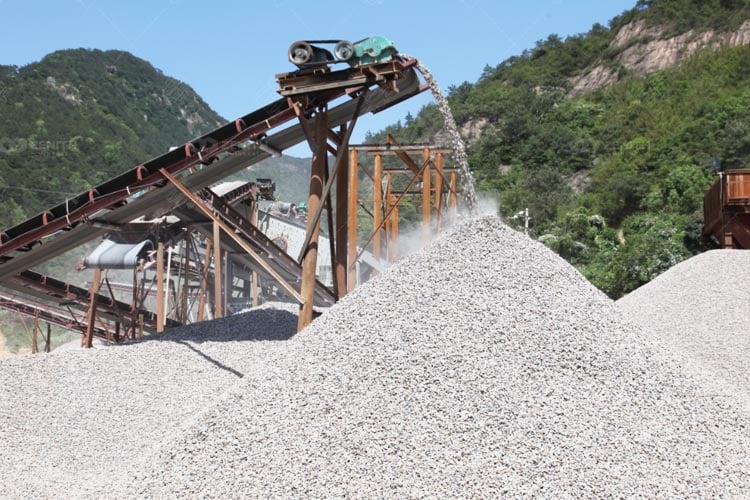
Part VI: How ZENITH Crushing Equipment Produces High-Quality Standard Aggregates
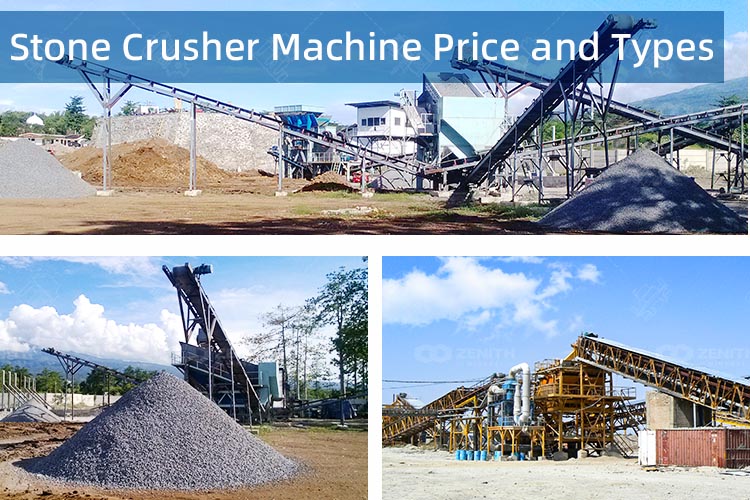
As a professional global crusher manufacturer, ZENITH supplies complete stationary and mobile crushing solutions to produce ASTM C33-compliant crushed stone and recycled aggregates for quarries and demolition recycling plants worldwide.
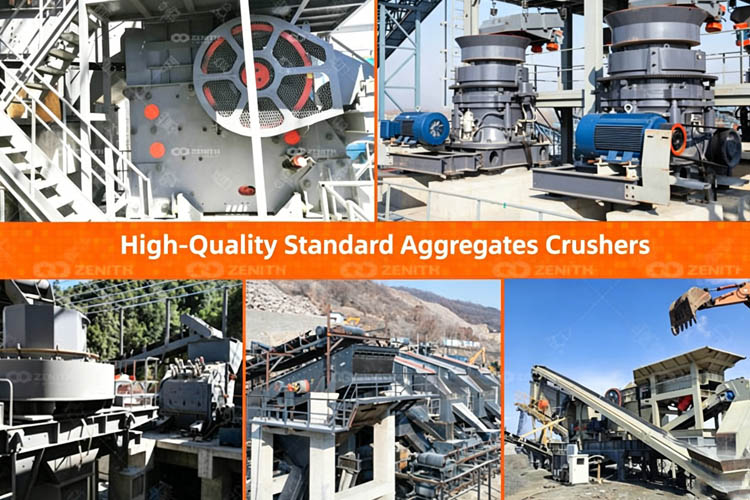
1. Primary Crushing Unit: Jaw & Gyratory Crushers
Heavy-duty jaw crushers handle medium-hard rock for small and medium production lines. Gyratory crushers support 2000–10000 TPH ultra-large quarry projects with stable primary crushing performance.
2. Secondary & Tertiary Crushing: Impact & Cone Crushers
Impact crushers deliver perfect cubical aggregate shapes with minimal flaky waste. Hydraulic cone crushers process hard granite and basalt for high-strength construction stone. VSI sand makers produce fine manufactured sand from crushed rock and waste concrete.
3. Precision Screening & Washing Systems
Multi-deck vibrating screens achieve accurate size separation for #57, #67 and crusher run aggregates. Sand washers remove mud to produce clean drainage stone matching highway engineering standards.
4. Mobile Crushing Plant for On-Site C&D Waste Recycling
Tracked and wheeled mobile crushing stations integrate feeding, crushing, screening and magnetic separation. They can be directly driven to urban demolition sites to turn waste concrete into usable recycled crushed stone, eliminating high raw material transportation and landfill fees. No concrete foundation installation is required for fast commissioning within 48 hours.
Part VII: Extending the Service Life of Crushed Stone and Gravel in Engineering Applications
In practical engineering projects, choosing the right aggregate is only the first step. To maximize the service life of roads, foundations, and drainage systems using crushed stone or gravel, consider these best practices:
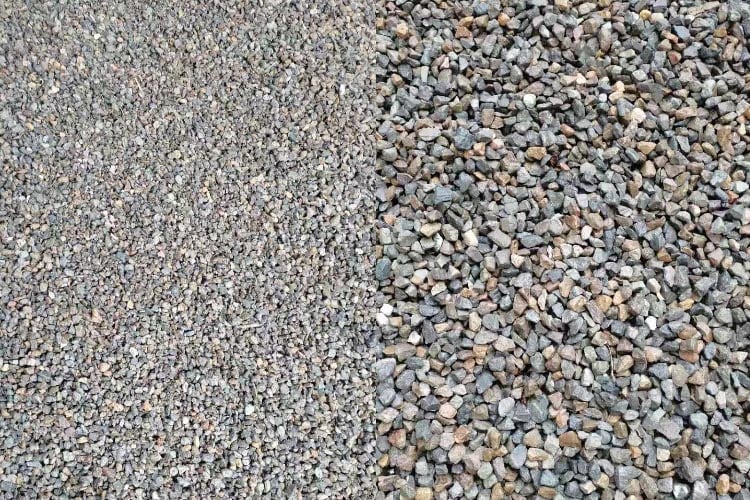
- 1. Select the Right Particle Size: Balance construction ease with functional performance. Finer materials compact better for bases; coarser materials provide better drainage.
- 2. Use High-Quality Rock: Choose durable rock species like granite or hard limestone to achieve higher strength and longer life.
- 3. Ensure Proper Compaction: Adequate compaction reduces voids in the material, increasing overall strength. Use the correct moisture content for optimum density.
- 4. Consider Environmental Protection: In harsh climates, use proper drainage and sealing to prevent frost damage or erosion.
- 5. Implement Regular Maintenance: Inspect surfaces and foundations regularly. Promptly repair, patch, or replenish materials to prevent small issues from escalating.
- 6. Plan for Reconstruction: At the end of its service life, plan for reconstruction by clearing deteriorated material and rebuilding the subgrade or foundation.
Selecting the correct aggregate for your project is not complicated, but it requires knowing the differences between material types and standard sizes. By understanding the unique properties of crushed stone vs. gravel, and by using the ASTM size guide (#57 for drainage, #411 for driveways, #8 for concrete), you can ensure your project is built on a durable, cost-effective foundation.
FAQs About Crushed Stone and Gravel
Q1: What is the difference between crushed stone and gravel?
Crushed stone is a man-made aggregate produced by mechanically crushing rock such as limestone or granite. It has angular, sharp edges that lock together when compacted, making it ideal for stable bases. Gravel is naturally formed by erosion and has smooth, rounded surfaces. It offers superior drainage and is commonly used for landscaping and decorative projects.
Q2: What is #57 stone used for?
#57 stone is the most common crushed stone grade, measuring 3/4 inch. It is a 'clean stone' (washed, no dust) and is the gold standard for drainage applications like French drains. It is also widely used as aggregate in concrete and asphalt and as a base layer for construction projects.
Q3: What is pea gravel and what is it used for?
Pea gravel consists of small, smooth, rounded stones about 3/8 inch in size. It is comfortable to walk on, provides excellent drainage, and does not compact. It is commonly used for garden pathways, playgrounds, drainage fill, and decorative ground cover.
Q4: What type of gravel is best for a garden pathway?
Pea gravel is the best choice for a garden pathway. Its smooth, rounded stones are comfortable to walk on, create a pleasant crunch underfoot, and come in a variety of natural colors.






 24/7 Online